
Dean Peters
Principal Consultant and Trainer

Every provider in this category says they transform teams. Few will tell you when it has happened. We run Team Transformation Checkpoints at 3, 6 and 12 months to report movement in your team’s maturity, and we meet you each time to show you where to focus next.
Anyone can teach a framework. That was never the hard part.
The hard part is the system your team goes back to, where nobody ever defined the roles and the roadmap belongs to whoever escalated hardest. Training is only as effective as the system around it, which is why the diagnostic comes first. You find out what training will solve and what it won’t before you’ve spent anything.
The strongest predictor isn’t the curriculum or the instructor. It’s whether your managers know what was taught and stay on it afterward. Gartner puts the lift at up to 26% when managers connect their people to the right development instead of coaching everything themselves.
So, we ask four things of your managers, and we say so before you sign: a briefing beforehand, a review of each participant’s first application, a plan for running it through their 1:1s, and the follow-up coaching sessions.
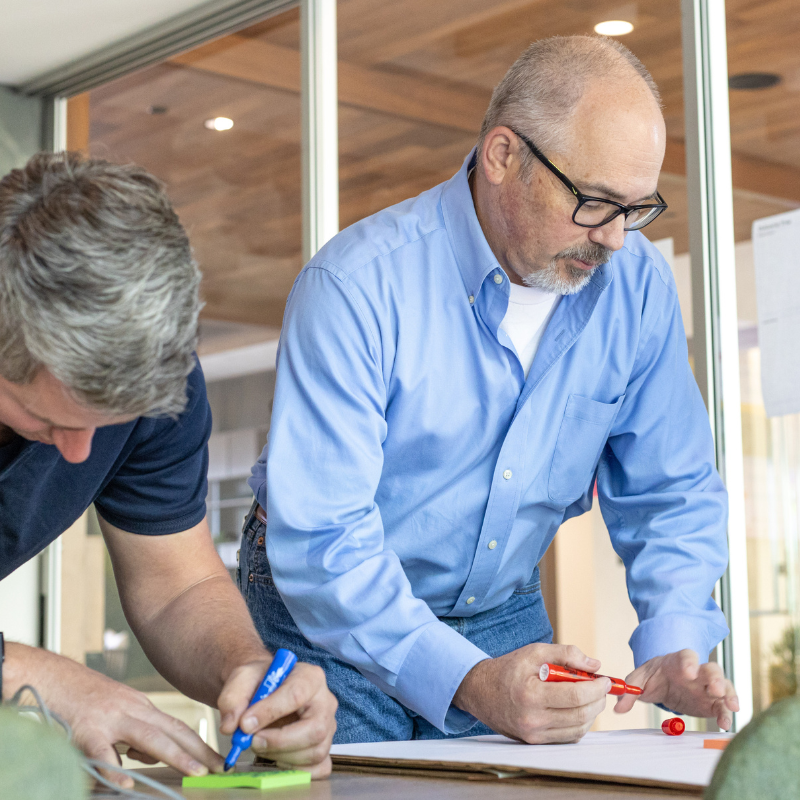
Your product managers need the job they already have to take less time and hold up better under questioning. AI sits inside the exercises your team runs, and they leave knowing how to use it to make real decisions.
Everything above is how we work with a whole product org. If it’s just you, the same curriculum runs as open training, live online, in person, or self-paced. Four tracks, each ending in a credential.
The core craft, discovery through delivery. Strategy that connects to what customers will pay for.
Build AI products that survive a business case, and run your own week with AI instead of around it.
Design thinking and rapid experimentation, applied to digital products at scale.
Roadmaps that survive contact with a fast delivery org. Agile practice that doesn’t collapse into ticket grooming.

Every track ends in the corresponding AIPMM or Productside certification exam, with the prep, the practice and the support around it. You walk away with the artifacts you built during the training and a credential recruiters and L&D teams recognize.
AIPMM is an independent association and not a Productside brand. The people assessing you don’t work for the people who taught you.
Our consultants have shipped products and carried a P&L. They write your recommendations and guide you through the whole engagement. The person at the front of the room has done the job you’re asking your team to do, under the same pressure.
Principal Consultant and Trainer

Principal Consultant and Trainer

Principal Consultant and Trainer

Principal Consultant and Trainer

Jaime Lamphear
Senior PM at HealthStream

Cody Stokes
Product Manager at Cirrus Insight
We measure what matters to our clients: outcomes. Every engagement opens with a Team Assessment across six dimensions of product management and reports movement on that same assessment at 3, 6 and 12 months. The training differs structurally too. We put the whole team through one continuous arc on one case, instead of letting each person select modules from a library. Full row-by-row comparison here, sourced and dated.
A Team Assessment before you’re quoted, a 150-criteria diagnostic where the picture warrants one, an Individual Skills Assessment for every participant, one continuous training arc for your whole team on a case built from your domain, then a Team Implementation Plan, a playbook, named change champions, manager briefings, a reviewed first application and follow-up coaching. Checkpoints follow at 3, 6 and 12 months. [Full breakdown on the corporate training page.]
The Team Assessment measures the team. It runs before you’re quoted, scores six dimensions of product management, and gets re-run at 3, 6 and 12 months on the same instrument, which gives you a before and after number. The Individual Skills Assessment measures each person. It shapes what the program covers and runs again after training so your PMs can see their own movement.
We wrote a buyer’s guide for exactly that. It scores any provider against eight criteria, and course content deliberately isn’t one of them. Use it on us. [Link to the buyer’s guide.]
Sometimes, and we’ll tell you when. Build when the problem is propagating practices you already know are good, buy when the problem is that you aren’t sure they are.
Two things most buyers haven’t costed: Industry research from ATD puts development effort at roughly 40 hours per hour of simple instructor-led training and around 100 hours per hour for complex programs, which for a 24-hour core program is a year-one build of roughly $88,000 at the simple end and $212,000 at the complex end, before a single person is trained. The build is also gated by your product subject-matter expert. At a realistic 20% of a senior leader’s week, their share alone takes around 36 weeks.
There’s a risk that’s harder to price. An internal build encodes your current practice, including the parts that are wrong, and everyone in the room agrees with the material.
Where internal build wins, and it wins decisively, is sustained high cohort volume with stable content and teachers already on staff. At one to three cohorts a year it rarely competes. Most organizations sit in the middle, where the arithmetic is close enough that cost shouldn’t be what decides it.
From your participants, the willingness to apply the method to their own product within two weeks of training. From their managers, four things we name before you sign: a briefing beforehand, a review of that first application, a plan for running it through 1:1s, and the follow-up coaching sessions. Whether managers do this is the strongest predictor we know of whether a program works.
Yes. The full sample diagnostic report and the Team Assessment itself are available on request.
In-person and live online instructor-led training, plus self-paced options. Private team training runs as a continuous arc built around a case that mirrors your domain.
Yes. Training includes the corresponding AIPMM or Productside exam and lifetime certification.
Training on its own usually doesn’t stick. Harvard’s Michael Beer puts the share of corporate training that works at around 10%. Our diagnostics almost always turn up organizational problems alongside the training need, which is why the diagnostic comes first and the implementation work runs well past the training itself.
On the Team Assessment, before and after, re-run at 3, 6 and 12 months, reported across all six dimensions instead of as attendance and satisfaction.

Productside AI · replies instantly
Drop your details and I'll be right with you.
Hugo can make mistakes. Please verify important information.
How was your chat with Hugo?
Hey, I'm Hugo — how can I help?