CORPORATE PRODUCT MANAGEMENT TRAINING
Train your whole product team. Measure what moved.
You have seen what we claim. Here is exactly how an engagement runs.
One program, scoped to your team, quoted once after the assessment tells us what it needs to cover. Not a seat count. Not a course you pick from a list. Roughly four months from first assessment to first checkpoint, and we are still there at month twelve.
Thirty minutes. You will leave knowing whether training is even your problem.

THE ENGAGEMENT
Four months, start to first checkpoint.
Every engagement runs the same shape. What changes is what the diagnostic finds and what the training has to cover.
Every product manager takes the Individual Skills Assessment across 14 skill dimensions. Around 30 minutes each. A team assessment runs alongside it.
Where the picture warrants it, a 150-criteria Blueprint diagnostic: interviews, a review of your actual artifacts, and a written report with prioritized recommendations. You can act on that report without us.
We agree what the program covers, based on what the assessment found. Your managers are briefed before their people walk in.
One continuous 24-hour arc for your whole team, worked on a case built to mirror your domain. AI sits inside the exercises.
Every participant applies the method to their own live product. Their manager reviews the work.
The same consultants, back in. Not a check-in call.
The assessment from week one, re-run on the same instrument.
Implementation support runs to here as standard.
Same instrument, same dimensions, reported as movement.
The Team Assessement in week one and the assessment in month twelve are the same instrument. That is what makes the two numbers comparable, and it is the only part of this timeline that no other provider in the category currently offers.
Nine things you keep.
Everything below is yours at the end, in a format your team can run without us.
Ask to see the sample diagnostic report and the assessment instrument before you commit. We will send both, without a signature.
This asks something of your managers. We would rather say so now.
Most vendors need nothing from you but a room and a purchase order. We need four things from the managers of the people being trained, and we put them in the agreement.
A briefing session
Review your report’s first application to their own product
Run the 1:1 plan we give you
Join the coaching sessions
Ask to see the sample diagnostic report and the assessment instrument before you commit. We will send both, without a signature.
Your team. Not a public cohort with strangers in it.
Every session is your organization only. Small enough that everyone speaks and large enough that the arguments are real.
Who should be in it
your product managers, their direct manager, and the cross-functional partners who will be in the room when the decisions get made.
Who should not
your product managers, their direct manager, and the cross-functional partners who will be in the room when the decisions get made.
About the case your team works
We build it before the training, from your domain, your constraints and the shape of the decisions you actually face.
It is not your live roadmap. Your live work comes two weeks later, as the reviewed first application, where the method meets your real constraints without the room spending a day relitigating decisions people already made.

TJ Adams
Vice President, Systems Product Strategy and Development at QSC
“This is my second company where I’ve used Productside private training. It gets people to think like Product Managers. Then it’s easier to scale the company since everyone uses the same language and tools.”
When to call us, and when not to.
Your PMs came from BA, delivery or engineering roles and were never given the same playbook
You can name the gap but not size it
Someone above you is asking what the L&D spend bought
Your managers can commit to what Section 04 asks
You need a broad catalog covering every discipline in the business. Buy a platform for that
You need working AI shipped in your stack by day 60
You want the operating model redesigned and run for you
You need one person trained. Send them to an open course instead
One program, quoted once, after the assessment.
We do not quote per seat, and we do not quote before the assessment, because until we have measured the team we do not know what the program has to cover.
What drives the number: how many product managers, whether the Blueprint diagnostic runs, how much implementation support you want past month four, and travel if it is in person.
What does not drive the number: how many modules you pick. There are no modules to pick.
How the 24 hours are arranged.
The arc is continuous, which is the point of it.
Among our certified graduates, 38% of those who trained with a live instructor reported a promotion within 18 months, against 24% of those who studied on their own.
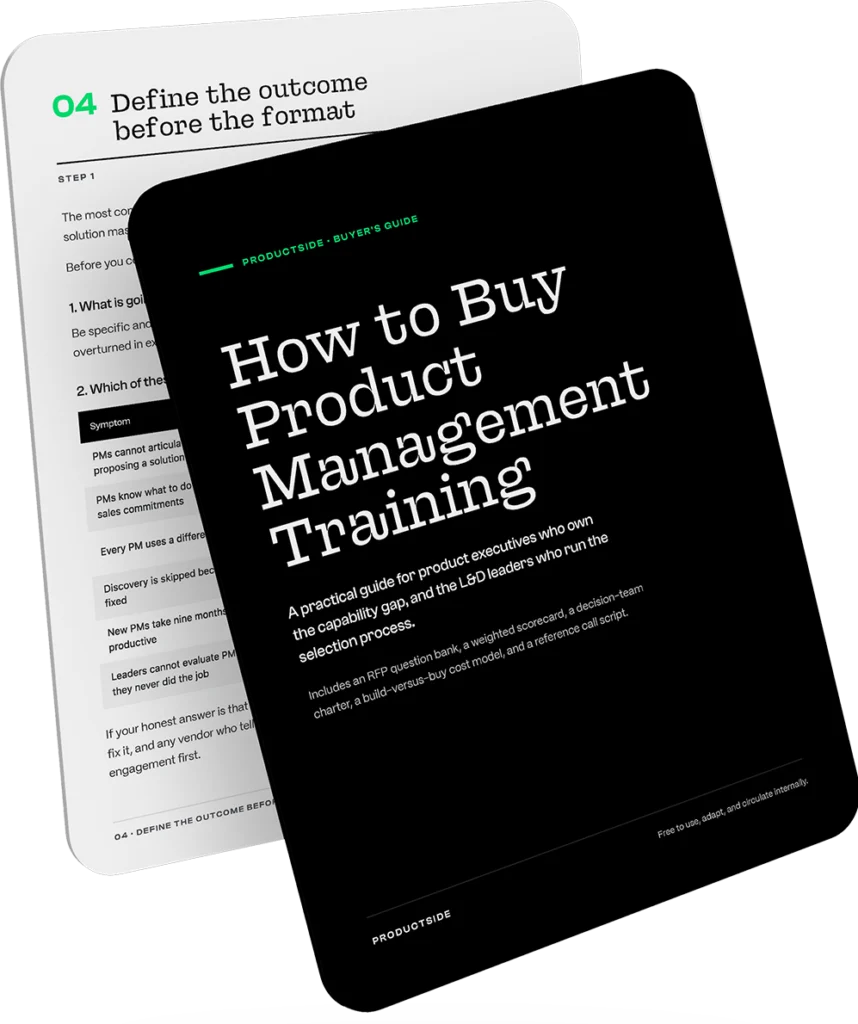
Here is how to evaluate us, and everyone else on your list.
We wrote a buyer’s guide for product and L&D leaders choosing a training partner. It scores any provider on eight criteria, and content is deliberately not one of them.
Free to take, adapt and circulate.
What changed, in their words.

Kimberly Johnson
Product Manager at The Home Depot
“I enjoyed the continuous learning and feedback. Being in a small group allowed us to be more interactive. This was the best business class I’ve had in a long time.”

Chris Barylski
Product Manager at Otava
“I would absolutely recommend that anyone either thinking about moving into the product management field or new to product management, take a look at Productside and the Optimal Product Management course.”

Eric Haar
Transition Specialist at CreativeOne
“The best part of training were the trainer’s stories, which really helped frame the content, and the group breakouts, which really helped solidify the concepts in a concrete way.”

Danielle Chapleau
Product Supply Manager at Card Kingdom
“I got everything I needed out of the class. I feel ready and prepared to take on my role with more context into how I should be approaching new and retiring products.”

Patrick Perl
Customer Experience Leadership at H&R Block
“The course highlighted that AI products should be focused on solving a problem, not just reducing expenses.”

Jennifer Temple
Sr. Pricing Product Manager at RingCentral
“I got way more out of this class than I was expecting in how to apply Agile principles in my day job and communicate more effectively with stakeholders.”

Alexander Rojinski
Product Manager at Transplant Connect
“Taking the course was like completing a mini-MBA but focused entirely on Product Management and the Product Lifecycle.”

Krasimir Dimitrov
PO/PM/Senior BA at Astea
“The launch readiness content is extremely relevant and valuable, providing techniques that can be directly applied to real-world scenarios.”

Nicole Torrillo
UCaaS Product Manager at Northland Communications
“I really like the resource templates provided. They explain the steps well, and the problem statement template makes defining the problem easier!”

Mike Freier
Principal and Lead Consultant at Product Management Consulting Group Inc.
“The AI course gave me hands-on experience with advanced prompting and buyer personas, which I can directly apply in my day-to-day work to improve market intelligence and storytelling.”

Sara Athanas
Digital Services Executive at Vodafone
“The Productside Blueprint provided a fresh perspective, emphasizing the importance of a customer-centric approach in product development.”

William Campbell
Head of Design at Actionstep
"“Roger is AWESOME. From his own war stories, to his ability to involve everyone, give time for questions and clarifications by giving more examples. Truly impressive.”"
What the first call covers.
Thirty minutes, with a consultant who has run product teams rather than a qualifier reading a script. We will walk the shape of your team, what you already know is broken, and whether an assessment is the right first step.
You will leave with a straight answer, including “not yet” and “not us” when those are the right ones.
Frequently Asked Questions
What is corporate product management training by Productside?
Productside has a library of courses and workshops available for enterprise teams. We specialize in creating custom training programs to close skill gaps and support product management best practice adoption across your organization.
How do you customize your training?
We assess your current state and future goals, then tailor curriculum, exercises, and examples to your industry, products, and workflows—whether you’re a scale-up or a global enterprise.
What certifications are included for team participants?
Programs can include AIPMM-aligned certification pathways with role-based tracks for Product Managers, leaders, and stakeholders.
How is corporate training different from public courses?
You get dedicated instructor time, private team coaching, enterprise feedback loops, and ROI tracking—often as part of a broader transformation package with advisory, assessments, and coaching.
What outcomes do companies typically see?
Faster rollouts, tighter cross-functional alignment, stronger ROI from launching profitable products, and measurable capability lift—backed by shared language and repeatable practices.