AI has dramatically reduced the cost of building “something impressive.” With a few prompts and an API key, teams can stand up prototypes in days. But across industries, the results are eerily similar: pilots that stall, features that never move the needle, and leaders who quietly lose confidence in “AI initiatives.” These are the patterns at the heart of the most costly AI product management mistakes teams make today.
What’s going wrong isn’t the technology. It’s product thinking.
AI doesn’t forgive fuzzy discovery, vague outcomes, or weak validation. In fact, it magnifies them. Teams that were already struggling to connect features to outcomes now find themselves scaling the wrong work even faster.
Let’s look at the five most common mistakes product managers make with AI, illustrated with real-world patterns we see repeatedly, and how a Productside Blueprint-driven approach avoids them.
Mistake #1: Starting With the Solution (The Most Common AI Product Management Mistake)
“We need an AI chatbot.”
How many of you have heard this from your leaders?
A mid-market B2B SaaS company came into an engagement convinced this was their next big move. Sales wanted it for demos. Support wanted it for ticket deflection. Leadership wanted it because competitors had one.
So the team built it.
The chatbot launched on time, answered questions accurately, and even reduced a small number of low-value tickets. But three months later, usage plateaued. Support costs barely changed. Customers still escalated complex issues to humans.
What went wrong?
The team started with the solution, not the problem. No one had articulated a clear product outcome.
They only articulated outputs:
- Launch a chatbot
- Answer FAQs
- Reduce tickets
This is exactly the trap the many product managers fall into: confusing outputs with outcomes.
An output answers what did we build?
An outcome answers what changed for the customer or our business?
What should this team have asked instead?
- What job is the customer trying to get done when they contact support?
- Where does delay or friction actually hurt them?
- What measurable outcome would indicate success?
Mistake #2: No Clear Outcome Means No Clear Product Manager AI Strategy
Another organization, this time in financial services, set out to use AI to “improve decision quality” for frontline advisors.
That phrase sounded great in slides and roadmaps. But without a grounded product manager AI strategy, the team couldn’t answer basic questions when it came time to evaluate progress:
- What does “better” mean?
- Better than what?
- For whom?
Without a clear outcome, every discussion became subjective. Stakeholders debated opinions instead of evidence. The AI team optimized for model accuracy, while the business cared about downstream decisions.
Good product outcomes are stable, measurable, and tied to customer success, not technology choices.
What this looked like in practice:
- No agreed success metric
- Validation postponed until “after launch”
- AI judged by usage, not impact
They eventually rewrote the outcome as:
Increase the likelihood that advisors select a compliant, optimal investment strategy for a given client profile.
Now the AI work had direction. With data requirements clarified, validation became possible. The conversation shifted from “Is the model good?” to “Did decisions improve?”
Mistake #3: Ignoring Data Realities
One of the most underestimated AI product management mistakes is assuming the data is ready. A logistics company wanted to use AI to predict delivery delays and proactively notify customers.
On paper, it was a great idea. In practice, it fell apart.
The data told conflicting stories:
- Historical delivery data was incomplete
- Manual overrides weren’t captured consistently
- “Delay” meant different things to different teams
The product team assumed data readiness because dashboards existed. But dashboards aren’t the same as decision-grade data.
There’s a hard truth out there when it comes to data: garbage in, garbage out. This is especially true with AI.
AI doesn’t fix data problems; it automates them.
These are symptoms we see over and over:
- Models that perform well in test environments but fail in production
- Endless debates about “why the AI was wrong”
- Erosion of stakeholder trust
What changed when the team stepped back and treated data quality as a product constraint, not a technical afterthought, progress resumed? They narrowed scope, defined guardrails, and aligned on what the AI could (and could not) be trusted to do.
Mistake #4: Overtrusting AI Outputs
One healthcare-adjacent platform introduced AI recommendations to help clinicians prioritize cases. The output was confident, articulate, and fast…Too fast.
Clinicians began deferring judgment to the system, even when context suggested caution. Edge cases slipped through. Eventually, leadership intervened. It wasn’t because AI was wrong all the time, but because no one knew when it might be wrong.
This is one of the AI product management mistakes that tends to emerge after launch rather than before: over-trusting outputs without designing for when the system fails.
We cannot treat AI as a source of truth. It is merely a collaborative partner.
So, what went missing here?
- Clear confidence signals
- Human-in-the-loop escalation paths
- Explicit guardrails for autonomy
The clear lesson is that aligned autonomy matters. AI should support decisions, not silently replace them. Trust must be designed, bounded, and continuously validated.
Mistake #5: Skipping Validation
Perhaps the most expensive mistake I see Product Managers making with AI is skipping validation because “the demo worked.”
A retail platform rolled out AI-driven demand forecasting nationwide after a successful pilot. Early numbers looked promising. Six months later, inventory imbalances emerged: localized demand patterns the model hadn’t learned were now being amplified.
Why wasn’t this caught earlier?
Because validation stopped once the model shipped.
Among recurring AI product management mistakes, this one compounds fastest. I cannot emphasize enough the discovery cycle of: hypotheses, validation, and learning loops, not one-time launches. AI systems evolve with data, usage, and context.
Without ongoing validation, small errors compound into systemic failures.
How to Fix AI Product Management Mistakes: Applying the Blueprint
The Productside Blueprint doesn’t change for AI, but the discipline must increase.
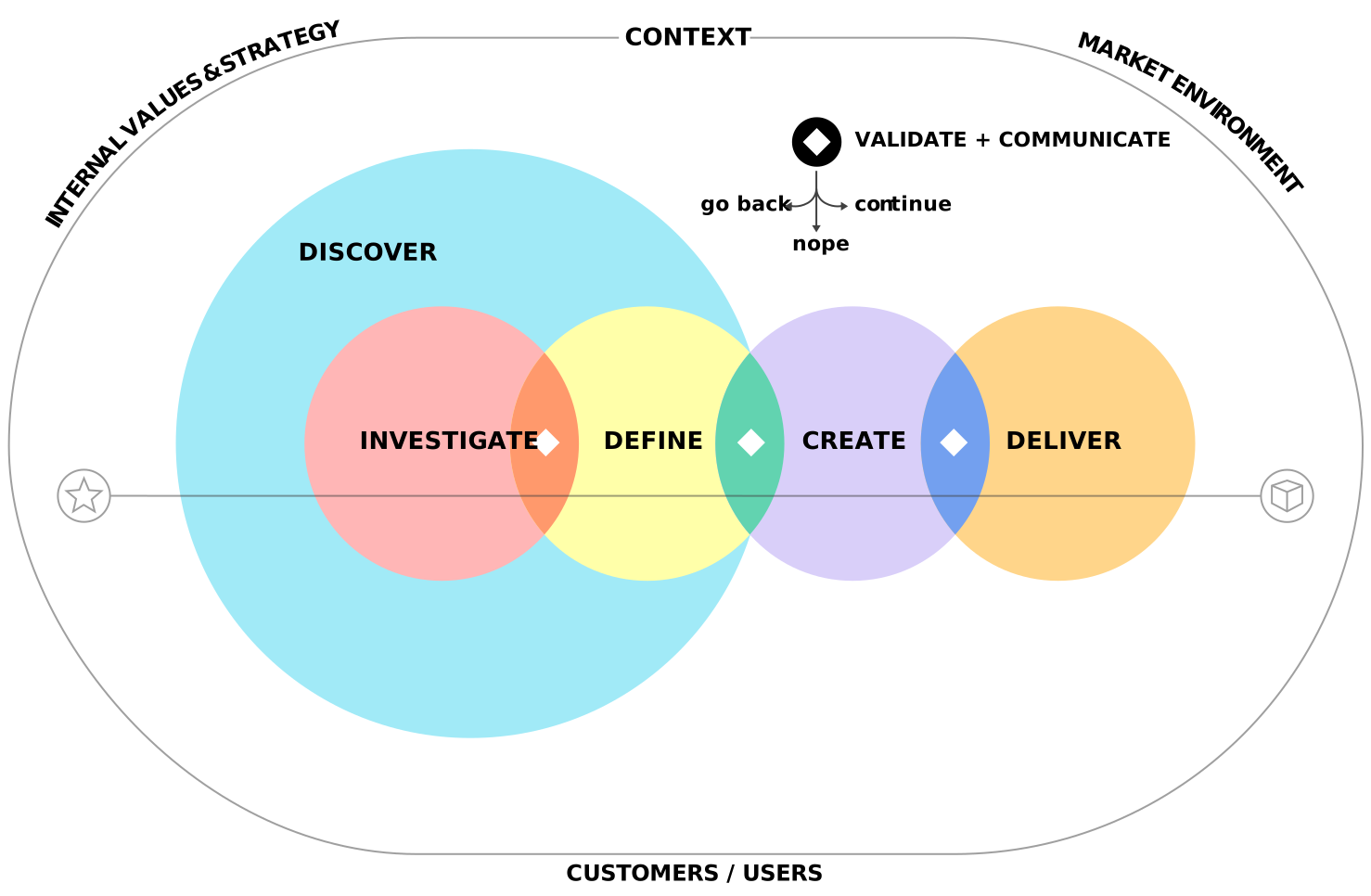
1. Start With Structured Discovery
Before any model selection:
- Identify the job to be done
- Define the desired product outcome
- Separate business outcomes from product outcomes
Outcomes must be written without embedding a solution—”use AI” is never an outcome.
2. Make AI Hypothesis-Driven
Every AI initiative needs a real product manager AI strategy before a single model is selected. That starts with a hypothesis:
If we support X decision with AI, then Y behavior will change, resulting in Z measurable outcome.
This anchors AI work in learning, not assumption, and aligns directly with outcome-based roadmapping.
3. Design for Guardrails, Not Just Accuracy
Accuracy is table stakes. Trust is the product.
Product-aligned teams:
- Define where AI can act autonomously
- Define where humans must intervene
- Validate continuously, not episodically
4. Measure Outcomes, Not Outputs
Avoiding AI product management mistakes long-term requires tracking what actually changed, not what was shipped. Usage is not success.
Success is:
- Time reduced
- Errors avoided
- Decisions improved
- Risk mitigated
These are product outcomes, and they remain valid even as models change.
Final Thought: Clarity Before Scale
AI product management mistakes don’t happen because the models are bad. They happen because the fundamentals (discovery, outcomes, hypotheses, validation) were never solid to begin with.
AI doesn’t replace product management. It exposes it.
Teams that succeed build a product manager AI strategy first, and choose the model second.
The Blueprint works for AI for the same reason it works everywhere else: it forces clarity before scale.
And with AI, clarity isn’t optional.
- If the five mistakes in this article feel familiar, you’re not alone, and the fix isn’t a better model. It’s a better process. Our AI Product Management course is live online and instructor-led, and it’s built to help PMs and product leaders apply structured discovery, outcome-setting, and validation to real AI initiatives, so you stop scaling the wrong work faster.
- Are you seeing these patterns on your own team? Join the conversation on LinkedIn and tag @Productside. We’d love to hear which of the five mistakes hits closest to home, and what you’re doing about it.