
Your roadmap made sense when you had one product.
I remember that feeling. You had one product, one team, and every win moved the needle. Then you get promoted, or your company grows, or you acquire a competitor, and suddenly you’re staring at a family of products and wondering why the big job feels like it comes with less control, not more.
It’s more of a portfolio problem than a roadmap problem. And it’s exactly why product portfolio management looks completely different at enterprise scale than it did when you had one thing to defend.
Why the Job Changes at Enterprise Scale
I recently hosted a webinar with David Nash, a B2B SaaS CPO who’s run product at Intel, ADP Dealer Services, and a handful of publicly traded and PE-backed companies. We spent an hour breaking down why enterprise product management stops being about any single product and becomes a portfolio discipline. I want to share what we covered, because I think most PM leaders learn this the hard way, the way I did.
Here’s the arc. At startup stage, it’s you and maybe the CEO calling the shots. Every win is a good win. There’s no such thing as a bad customer. You throw stuff at the wall and see what sticks, and the whole game is finding product-market fit before the funding runs out.
At growth stage, you’ve usually acquired a product or two. The role gets bigger. Individual PMs have a little less freedom, but leaders are expected to know a lot more. You’re maintaining product-market fit for the original business while establishing it for the new one, and you’re doing it under investors who want a return in three or four years, not seven.
At enterprise scale, the game changes again. You’re no longer managing a product. You’re managing a family of products, often stitched together through acquisitions, and your investors don’t want explosive growth anymore. They want predictability. As David put it, you’re still trying to win the hearts and minds of your users, but now you’re working just as hard to win the hearts and minds of your investors.
If you’ve ever gotten the big promotion and thought, “wait, why do I have less agency than before?”, you’re not broken and you’re not alone. I hear that from PM leaders constantly. The move from “get my thing approved” to “keep the whole portfolio aligned” is a completely different job, and nobody hands you a manual for it. That’s really the essence of good product portfolio management: shifting your thinking from individual products to the goodness of the whole.
Segmenting the Portfolio: Five Lenses
David and I walked through five ways to look at a portfolio before you can score it. Here’s the rundown.
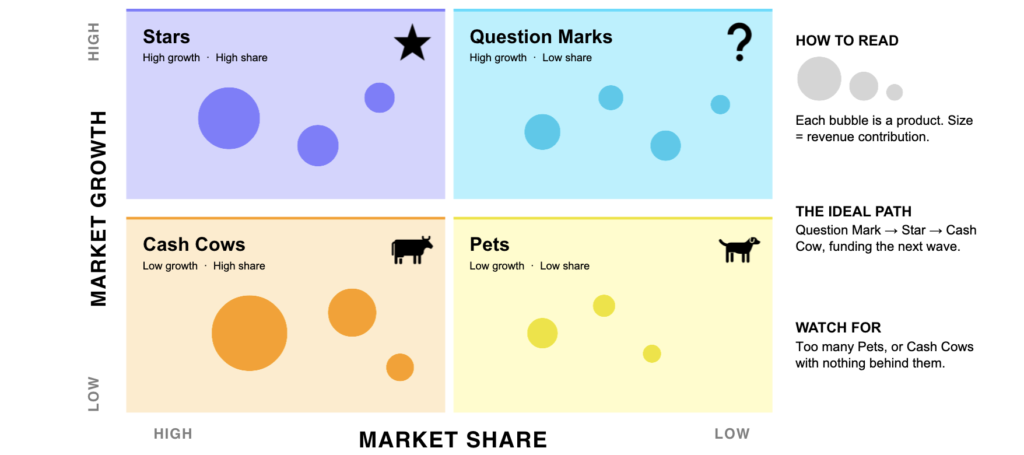
- The BCG Matrix. Every product sits somewhere on a grid of market growth versus market share: Question Marks (high growth, low share), Stars (high growth, high share), Cash Cows (low growth, high share), and Pets (low growth, low share). The ideal path is Question Mark to Star to Cash Cow. Watch for a portfolio with too manyPets, or Cash Cows with nothing behind them to fund next.
I’ve lived this one personally. Years ago, I ran a $100 million cash cow business built on early wireless internet infrastructure, right as we were laying groundwork for smartphones. I had a long list of features I wanted to keep building. My VP sat me down and told me, flat out, to stop asking for more resources. My job now was to fund the newer, riskier bets, not keep growing mine. I didn’t have a scorecard at the time. I just had a hard, disappointing conversation and a lesson I never forgot.
- Strategic Fit. Sometimes the business you’re in isn’t the business you should be in anymore. David spent 18 years at Intel, which pivoted from a DRAM company to a microprocessor company, essentially betting the whole business on a chip nobody wanted yet. Netflix made the same kind of pivot from DVDs to streaming. These strategic inflection points happen rarely, but recognizing one late costs a lot more than recognizing one early.
- Financial Metrics. This is where David’s point hit hardest for me: knowing your numbers is important, but it’s completely insufficient today. He told a story about spending two years at ADP Dealer Services turning off long-tail products, ones with a handful of customers each and revenue too small to justify the maintenance. Nobody wanted to make that call. He made it anyway, and it put $150 million straight onto the bottom line, without a single new feature or engineer.
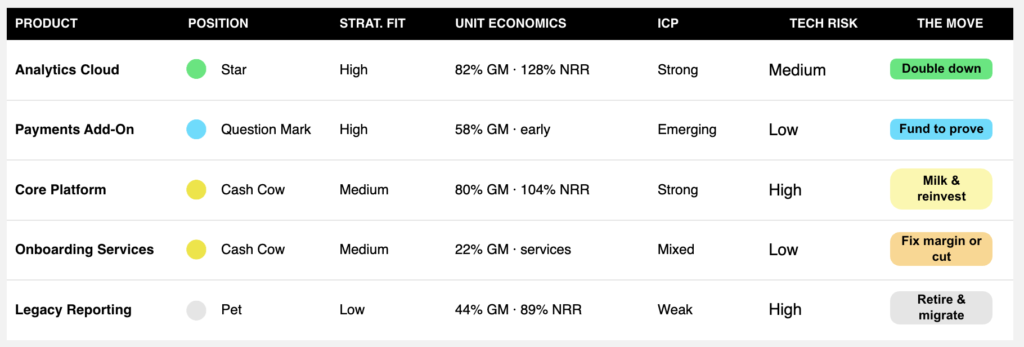
He also broke down unit economics for product managers as the actual language your investors speak: growth, net retention rate, gross margin, sales efficiency. For B2B SaaS, top-quartile benchmarks land around 125% net retention and 82% gross margin. If you can’t talk fluently in those numbers, you’re negotiating your roadmap in a language your CFO doesn’t use.
- Ideal Customer Profile. Enterprise products get bloated because for years, nobody said no to a customer request. The fix is defining who you can serve best, by industry, size, tech stack, and pain point, and being willing to walk away from customers who don’t fit. Sales loves this clarity, because it tells them exactly who to call and who to stop chasing.
- Technical Risk. Every portfolio has a list of things everyone knows are risky and nobody has fixed. The move here is simple: score likelihood against impact, and make sure the red items get resourced before something breaks in public.
Building the Portfolio Scorecard
Here’s the part I think matters most: none of these five lenses works alone. Segment by BCG position without looking at unit economics, or by financial performance without technical risk, and you get a partial, sometimes misleading picture.
The Portfolio Scorecard pulls all five together into one view: portfolio position, strategic fit, financial metrics, ICP alignment, and technical risk, side by side for every product line. This is product portfolio management in practice, not theory. And I want to be clear about something, because David said it well: this isn’t a scorecard where you assign numbers, multiply by weights, and let a spreadsheet spit out an answer.
“Never become a prisoner to any spreadsheet or template,” David said during the webinar. “This is not going to be your Ouija board that tells you what to do and what not to do.” The scorecard’s job is to put every trade-off on the table, transparently, so the conversation about where to invest and where to cut is grounded in the same data for everyone in the room, not whoever argued loudest.
I’ll be honest: if I’d had this scorecard the day my VP told me to stop growing my cash cow, that conversation wouldn’t have felt personal. It would have been visible logic everyone already understood. That’s the whole point.
Rallying Sales, Finance, and Engineering Around the Scorecard
A scorecard nobody else sees is just your private opinion. It only works if you cascade it to every function that touches the portfolio:
- Sales and Marketing need the segmentation to shape commission plans, pricing, and messaging, so reps know not just what to sell, but why.
- Engineering needs guaranteed capacity reserved every quarter, not just once a year at roadmap planning, for tech debt and risk work.
- Finance needs a straight line from every product bet to a unit-economics metric, reviewed after the fact, not just pitched before it.
- Customer-facing teams are the beating heart of your company. David shared a story about a $100,000-a-year investment in a product analytics tool that surfaced friction points and ended up saving customers worth ten times that in revenue.
- Operations and Legal matter too. David’s team once picked up three full points of gross margin just by renegotiating cloud contracts, with zero engineering hours spent.
The throughline: continuous alignment beats transactional approval. Instead of pitching your product like it’s the smartest kid in class and begging for a yes, you’re constantly bringing every function along with the same picture of the whole portfolio. That’s the operating rhythm good product portfolio management runs on.
Where AI Fits into Portfolio Decisions
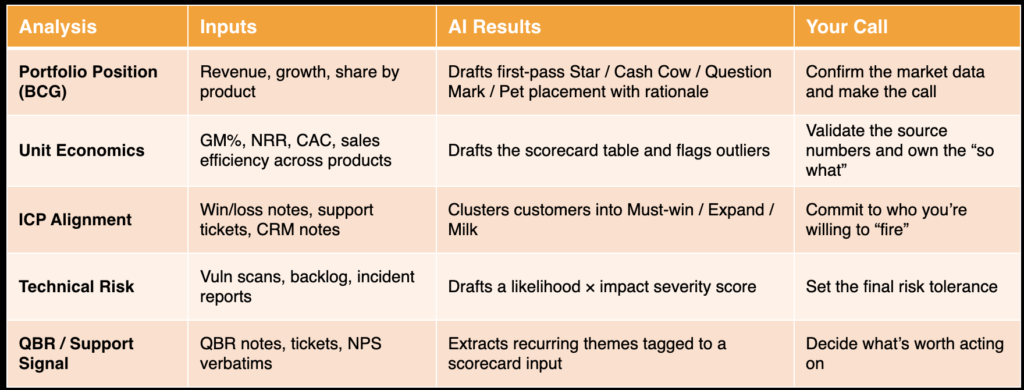
David and I were both direct about this: AI is your assistant here, not your decision-maker. It can draft a first-pass BCG placement, build out a scorecard table, cluster customers by profile, or mine your QBR notes for recurring themes. What it can’t do is make the call. David put it well: the models help you directionally, not transactionally. Use them for speed and for asking better questions. Keep the judgment yours.
Five Things to Take Back to Your Team
- Build a Portfolio Scorecard that fuses portfolio position, financial metrics, strategic fit, and ICP into one view.
- Don’t become a slave to the model. Revisit it and adjust what matters most as your conversations evolve.
- Align Sales, Finance, and Engineering continuously, working from the same picture, with every deviation documented.
- Tie every product bet to a unit-economics metric, and be ready to tell that story to your board.
- Use AI to sharpen your analysis. Keep the judgment calls yours.
The uncomfortable truth David and I both landed on? The biggest wins in his career weren’t launches. They were the unglamorous, sometimes painful calls to stop funding things that no longer earned it. That’s not a talent gap. It’s a framework gap. And it’s exactly what the Portfolio Scorecard is built to close.
- If you want to hear the full conversation (including real war stories on turning off products, pivoting Intel from DRAM to microprocessors, and building the Portfolio Scorecard live) watch the on-demand webinar The Portfolio Scorecard. It dives deeper into the unit economics benchmarks and practical prompts behind building your own scorecard.
- If you want to go further (not just understanding how to segment a portfolio, but learning how to build the strategic muscle to run one at enterprise scale) you’ll want to join our Optimal Product Management course.
- How is your organization deciding where to invest across your portfolio? Share what’s working (or not) on LinkedIn and tag @Productside. We’d love to learn how you’re building your own Portfolio Scorecard.