
Product Prioritization
Product Prioritization in Product Management is the process of determining the importance of various features and steps along the process of product creation. Having a standard framework for prioritizing your product roadmap can be invaluable to help you make smart decisions that ultimately lead to product and company successes.
For a more in-depth look on product roadmap prioritization, watch our on-demand webinar, 5 Secrets to Prioritizing Your Product Roadmap (The Right Way!) with Tom Evans and Jim Semick.
Deciding which features end up on your roadmap (and which features don’t) is one of the most important decisions product managers face. There are several ways to go about it. In this article, I’d like to talk about two methods: weighted scoring and the Kano model.
Prioritizing Your Product Roadmap: Two Methods
The weighted scoring model is popular among product management professionals and there is a growing awareness of the Kano model.
The weighted scoring model, while built on a combination of data points and educated guesses, is an attempt to bring objectivity to your product roadmap prioritization. Kano product management tries to focus more on the intangible benefits that specific features or initiatives will bring to customers.
Either model can work well in the right circumstances. And in some cases it might be worth trying both frameworks to help you prioritize your product roadmap.
The Weighted Scoring Model
The weighted scoring model is a framework that helps you prioritize a list of items using criteria of varying importance. It is popular among product management professionals for deciding which features end up on the product roadmap and which don’t. The weighted scoring model, while built on a combination of data points and educated guesses, is an attempt to bring objectivity to your product roadmap prioritization.
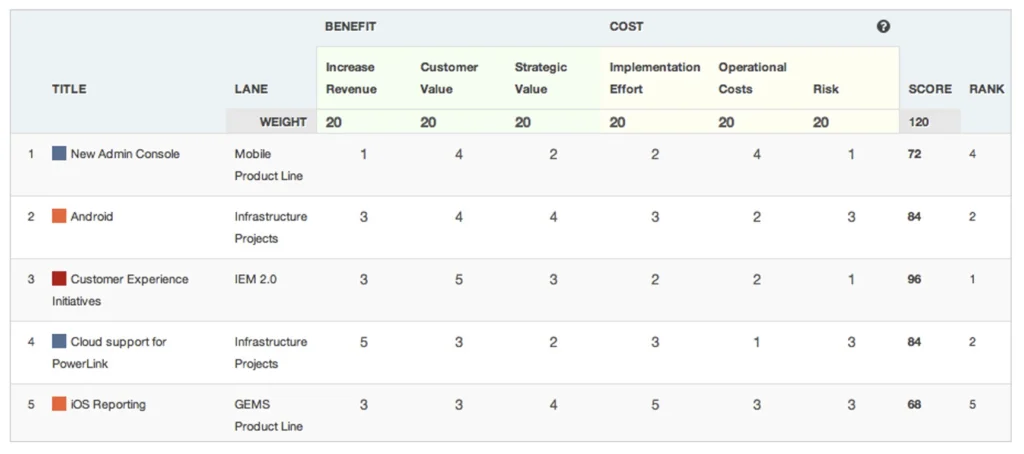
With a weighted scoring approach, you take your proposed features or initiatives, rank each of them using a benefit-versus-cost framework on a number of criteria, and then step back and use the scores you’ve come up with to decide which initiatives make the cut.
As you can see in the screenshot below, a sample weighted scoring page from our product roadmap software, you can use whatever criteria makes sense for your product and company objectives when evaluating contending initiatives against each other for prioritization on your roadmap.
In terms of potential benefits, for example, you can use real-world data — or, if you don’t have that at hand, educated guesses — to score an initiative on its ability to increase revenue, or to add customer value or value to the company itself. In terms of costs, you can evaluate an initiative on its complexity or level of difficulty to implement, or its hard-dollar operational costs, or even the risk it will fall flat with customers.
The point with the weighted scoring model is to quantify, to the best of your ability, each competing initiative on your list to help you prioritize the product roadmap.
Note: Whatever format or roadmap prioritization tool you use to build a weighted scoring model, I recommend you make the final output as visual as possible.
This will make it easier for you and your team to clearly see the entire landscape of possible items for the roadmap. It will also make it easier for you, when presenting your roadmap to executives and other stakeholders, to visually explain why you made the prioritization decisions you made.
Kano Prioritization Technique
In the Kano Prioritization Technique you evaluate features for their impact on the customer’s emotions in an attempt to find features that will delight your customers. This is in contrast to the Weighted Scoring Model which attempts to prioritize objectively across a wide variety of prioritization criteria.
Unlike the weighted scoring approach, where you assign quantitative values to each initiative to help make prioritization decisions more clinical and objective, the Kano model lets you view competing initiatives with a much more subjective eye.
Indeed, the Kano model is often explained as measuring product function against customer delight.
When prioritizing your product roadmap using the Kano model, you break out potential features into a series of categories, described below, and then weigh each in terms of its necessity versus its ability to delight. You’ll see a visual representation of the Kano approach in the graph below.
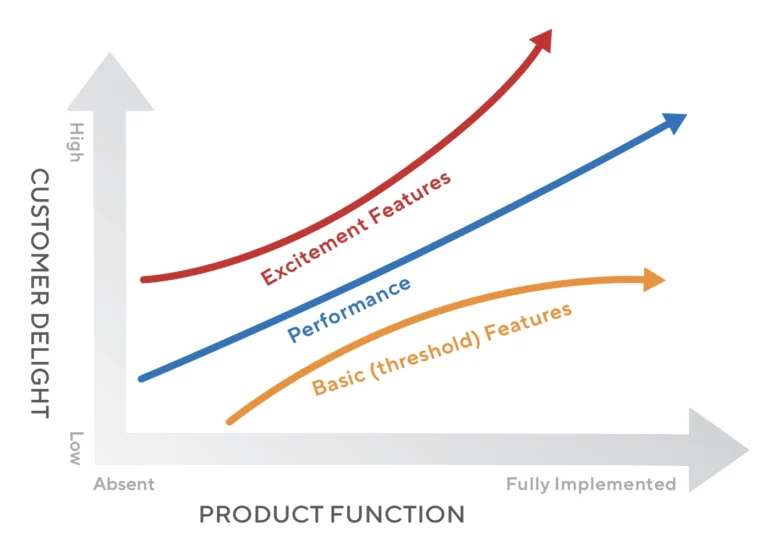
First, there are the threshold (basic) features. These are the features that have to be in your product. Your customers will expect them. Your competitors have them. They’re necessary.
But that doesn’t mean you need to continually invest a great deal of time, resources and development cycles into them. That’s because over time, you will experience diminishing returns in terms on the all-important “customer delight” from these threshold features.
Next, there are performance features. These are the features, for example, that make existing products faster and run more smoothly. If you put more investment in time and resources into performance features, this effort will in fact result in a linear, or proportionate, increase in customer delight.
But it’s important to understand that, like the threshold features, performance features are also somewhat defensive investments. In other words, you continue to invest in them at least in part because if you don’t your competitors will catch up with you.
Finally, there are the excitement features. These are the viscerally exciting elements of your product, the “wow” features — the things that your users will love and even tell their colleagues and friends about. And ironically, these are features your customers might not ever ask for — or even know they want.
This is where expertise will be so valuable — truly understanding your key personas and the problems they face. If you can include these excitement features — and they hit the mark with customers — your product will enjoy a disproportionate amount of customer delight.
Conclusion: Both the Weighted Scoring and Kano Model Can Work for Your Product Roadmap Prioritization.
A large part of a product manager’s job is making difficult choices about what makes it into the product — and what languishes (possibly forever) on the backlog.
Having a standard framework for prioritizing your product roadmap can be invaluable to help you make smart decisions that ultimately lead to product and company successes. The prioritization method you choose will depend on your product, your organization’s culture, and your product management style. Both the weighted scoring and Kano model work well in the right circumstances — as do the other approaches we explain in our product roadmap book.
Product Roadmap prioritization – the effort can make even the best Product Manager groan. While it is critical to your success, and so exciting to build a plan for the future, it’s a daunting task. It can be complicated and frustrating because there is no single right answer, and everyone, internal and external stakeholders alike, has an opinion or thinks they know the right answer. No matter what you propose, it will be heavily debated and perhaps even changed by senior executives. So, how can you ease the pain of prioritization and stick to your guns (despite executive “meddling”) to produce a product roadmap that you can be proud of?