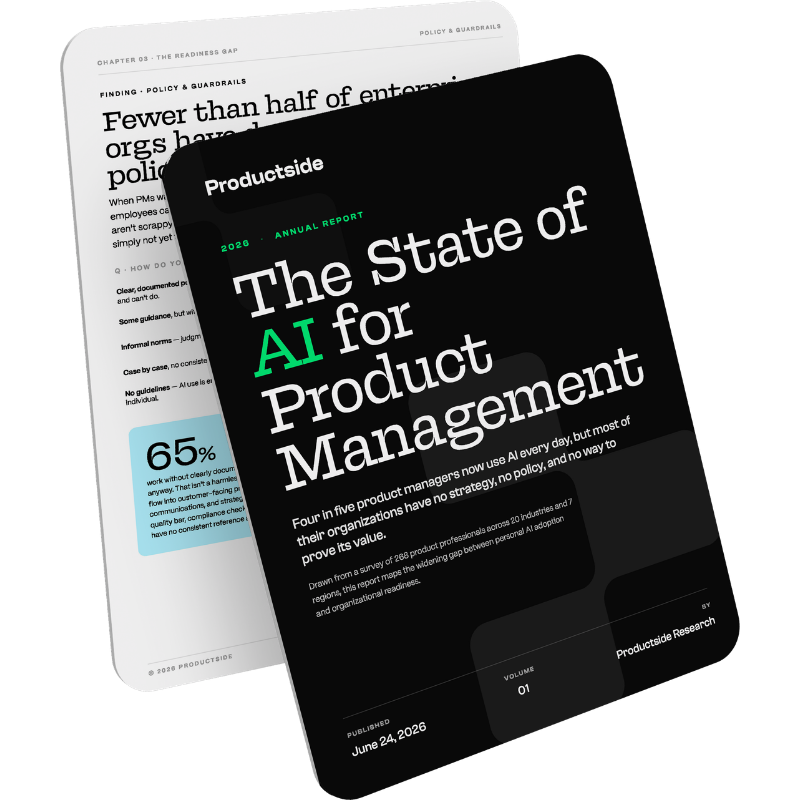
The State of AI for Product Management Report 2026
Your team is using AI. Your organization isn’t ready for it.
4 in 5 PMs use AI every day. Only 1 in 4 have a strategy to show for it. This report closes the gap between personal adoption and organizational impact.
Trusted by PMs and leaders from












This isn't opinion. It's data from 250+ product professionals.
We surveyed 250+ product professionals across industries, regions, and org sizes and asked the questions most reports won’t.
How AI decisions get made. Who owns them. Whether anyone’s measuring results. And how individual capability compares to organizational readiness.
- How PMs are using AI day-to-day and what's driving adoption
- Where strategy, ownership, and policy break down
- The biggest blockers to AI success
- Which skills separate high-maturity PMs from the rest
- How teams are (and aren't) measuring AI's impact
What's inside and why it matters for your team
The data tells a clear story. Personal AI use is high. Organizational readiness is low. The teams pulling ahead aren’t using different tools. They’re working inside a different structure.
- Where capability gaps are widest and which skills practice can fix vs. which ones it can't
- What high-maturity teams do differently: the behaviors that separate Stage 2 from Stage 4
- The strategy gap: only 23% have defined ownership; find out what the other 77% are missing
- Why most AI ROI measurement is too thin to defend and what to track instead
- How your industry, org size, and role shape your maturity: it's not one-size-fits-all including which company bands score highest and lowest.

Four things you'll walk away with
Your maturity stage
Understand exactly where you sit across five stages of AI readiness
Segment benchmarks
See how product professionals in your industry, region, and org size are performing
The real capability gaps
Not a list of tools but the skills and behaviors that determine outcomes
Clear next steps
Structured actions mapped to the Productside Blueprint

If you're responsible for AI outcomes on a product team, this is for you.
- VPs of Product and CPOs benchmarking their organization's readiness
- Directors and Group PMs closing the gap between individual use and team capability
- Product Managers who want to know where they stand (and what comes next)
- Product Ops leaders building the infrastructure AI needs to scale
- Anyone who's been asked "what's our AI strategy?" and didn't love their answer
Get the report
Know your maturity stage. Close the gaps. Ship AI work that moves the needle.
Frequently Asked Questions
What is the State of AI for Product Management 2026 Report?
The State of AI for Product Management 2026 is an annual research report published by Productside. It’s based on a proprietary survey of 250+ product professionals across industries, regions, and org sizes. The report examines how product teams are adopting AI, where organizational readiness breaks down, and what separates high-maturity teams from the rest. It covers personal AI adoption, strategy and governance gaps, the biggest blockers to AI success, skills development, and how teams are measuring — or failing to measure — AI’s impact.
Who is the State of AI for Product Management Report for?
The report is written for product leaders and practitioners who are responsible for AI outcomes on their teams. That includes VPs of Product and CPOs benchmarking their organization’s AI readiness, Directors and Group PMs working to close the gap between individual use and team capability, and individual contributors who want to understand where they stand and what comes next. It’s relevant across industries and org sizes.
What are the key findings of the 2026 report?
Five findings shape the report. First, 80% of PMs now use AI regularly — personal adoption has gone mainstream. Second, nearly half of organizations are actively investing in customer-facing AI, but most can’t clearly articulate the expected return. Third, only 23% of organizations have a clear AI strategy with defined ownership; the rest are developing one, running bottom-up experimentation, or have no discernible strategy at all. Fourth, the biggest blocker to AI success is data access and quality — not tools or budget. Fifth, most teams measure AI’s impact through time saved, which is useful but not sufficient to defend a strategy.
How is this report different from other AI reports?
Most AI reports are based on vendor surveys or aggregated sentiment data. The State of AI for Product Management 2026 is built on Productside’s proprietary survey of product professionals specifically — not IT leaders, not executives in adjacent functions, not general knowledge workers. The questions were designed to surface the gap between individual AI capability and organizational readiness, which is the dynamic most reports miss entirely. The result is findings that are directly actionable for product teams rather than broadly applicable to any function.
How can I use the report to improve my team's AI maturity?
The report maps findings directly to the AI Product Maturity Matrix, a five-stage framework developed by Productside that tracks both individual PM capability and organizational readiness. Readers can use the report to identify which maturity stage their team currently occupies, understand the specific skills and structural gaps holding them back, and find concrete next steps grounded in the Productside Blueprint. It’s designed to move from diagnosis to action, not just surface data.