Executive Summary
What does it take to move AI from a handful of power users to an entire product org? For TogetherWork, it started with getting nearly everyone in product into the same room for a day.
In spring 2026, Productside ran a custom one-day AI workshop for about 60 members of TogetherWork’s product organization at the company’s in-person Product Summit in Austin. The session paired the PRD Writer, a Claude skill built by TogetherWork’s Program & Product Ops Leader Annie Glass, with Productside’s grounding in why product artifacts exist in the first place.
Participants arrived with real requirements for the coming quarter and left with PRDs, story maps, epics and user stories ready for their backlogs. Self-rated proficiency on the workshop skills rose 18%, led by a 21.6% gain in prompting AI for epics. Months later, PRDs are a planning requirement, new hires learn the PRD Writer during onboarding, and one team used it to coordinate a data migration that went from days of manual work to about five minutes.
"Before this training, AI use across our product teams was scattered. A few people were doing interesting things with it, most weren't. Now it's how we work. Since the training, our teams ship faster and the quality of that work has gone up too. Customers are noticing the difference. What once took weeks or months, now takes mere days. We couldn't be happier with the progress."
Brooke Huling, Chief Product Officer, TogetherWork
About TogetherWork
TogetherWork is a portfolio of 25 brands that support community-based organizations with management software, embedded payments and managed services. Its brands serve five verticals: Arts, Member-based, Mission-Driven, Petcare, and Recreation & Wellness.

Behind those brands sits a product organization of about 75 people across product management, UI/UX design, product documentation and delivery, working with 56 Scrum teams. The team works across the US, with its main hub in Austin, Texas.

That spread is a strength for customers and a real test for consistency. With 25 brands and dozens of teams, every new way of working has to travel a long way to become standard.
The Challenge
TogetherWork’s leaders already believed in AI. The habit just hadn’t reached the people writing most of the requirements.
AI fluency stopped at the top
Over the past 18 months, TogetherWork went through a major transformation, and AI became a regular part of how its leaders talked about the future. The VPs running each business line used it every day. Usage amongst Mid-level product managers and product owners was mixed,, and adoption swung from one product line to the next.
"Our product org was really all over the map in terms of AI adoption... there needed to be a level set in terms of some basic skills and tool usage."
Annie Glass, Program & Product Ops Leader, TogetherWork
Encouragement from the top wasn’t closing the gap. As Annie put it: “Some pockets of product lines were adopting it and some were not, and so we felt like we needed to have a chance to literally have everyone in the same room.”
The foundations needed work too
AI fluency was only half the problem. Agile product practice varied widely across the org, and many people had never seen a story map. A good PRD could take weeks to write, so most teams skipped it. Too often, product managers sent engineering a pile of tickets instead of a shared picture of the user problem and how to solve it.
TogetherWork’s brief to Productside started out practical: get every PM using AI on real product work, in ways that drive efficiency gains. What it needed underneath was a common standard for what good product work looks like, so AI would speed up the right things.
Why Productside
TogetherWork’s CPO, Brooke Huling, had worked with Productside before and knew what the team could deliver. For Annie, the deciding factor was how Productside kept pulling the conversation back to outcomes while TogetherWork focused on skills.
"We were very focused on, we want to teach these skills, we want to teach these skills. But I think you guys kept reminding us, okay, but why do you need these skills? Let's make sure that we're always keeping the outcome in mind as well."
Annie Glass
Being neighbors helped too. With Productside close by in Austin, the two teams planned the session face to face and shaped it around TogetherWork’s own tool and the products its teams were about to plan.
The Engagement: A Custom One-Day AI Workshop
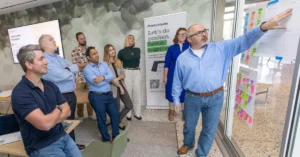
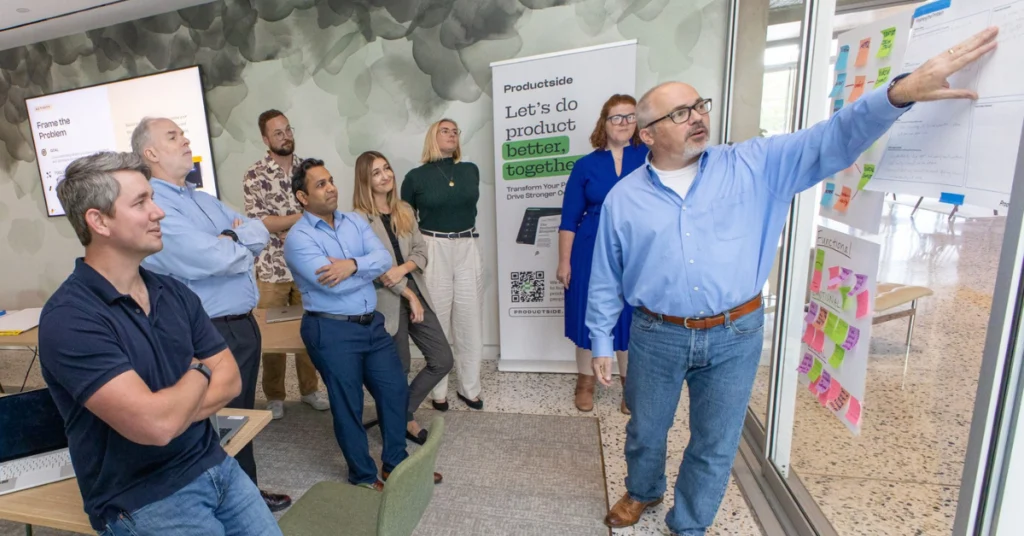
Productside’s Tom Evans led a one-day, hands-on workshop for about 60 people, roughly 80% of the product org, during TogetherWork’s three-day Product Summit in Austin. The room covered the whole product function, from the CPO and VPs of Product through product managers and product owners to UI/UX designers and delivery managers.
Built around TogetherWork’s own tool
Before the Summit, Annie built the PRD Writer: a set of Claude skills, bundled into a single plugin, that takes a product manager from an idea to a PRD, an epic story map, epics and user stories. She tested it with a few PMs first. Tom then reviewed and audit-tested the skill so he could frame the training around exactly how TogetherWork would use it.
That split shaped the day. TogetherWork supplied the tool, and Productside supplied the judgment to use it well: why good requirements matter and when to question what AI hands back.
How the day ran
Every participant brought a real initiative they needed requirements for in the coming quarter. The first job was practical: getting Claude Cowork installed and running on every laptop. Before anyone built an artifact, Tom took the room back to first principles.
"What Tom brought in was reminding everyone, like, why do we write a PRD? Why is it important to have clear requirements when you're bringing product and engineering together to build something? The point of all these artifacts is to have a conversation."
Annie Glass
From there, participants worked through the PRD Writer on their own initiatives. The curriculum targeted five skills:
- Telling an AI-generated draft apart from a product decision
- Prompting AI for epics that include assumptions and open questions
- Using AI to explore how a user flows through a feature, without letting it define the final structure
- Generating negotiable user stories instead of over-specified requirements
- Slowing the team down when AI output looks “done” but nobody has discussed it yet
Annie described the outcome she wanted for every participant: walking away feeling, “Okay. I used AI. It wasn’t as scary as I thought, and I actually have real things I could potentially push into Jira… I got a lot more done in one day than I would have gotten done in a couple weeks normally.”
Implementation Journey: From Workshop to Way of Working
The workshop put the PRD Writer in front of the whole org on the same day. What TogetherWork did over the following months turned it into a habit.
- Rollout and feedback. After the Summit, Annie made the PRD Writer available to everyone, gave teams time to use it, then ran a survey and shipped enhancements based on the answers.
- A planning requirement. A few months later, TogetherWork wrote it into quarterly planning. Under the company’s initiative tiers, every larger initiative past ideation now needs a PRD built with the skill, linked into the planning doc.
- Engineering in the loop. Annie asked Scrum masters and engineering leaders to hold product to it: when a PM brings a new feature, ask to see the PRD. Because the skill gets a PM “about 80% of the way there,” time no longer works as an excuse.
- Onboarding. New hires learn the PRD Writer as part of joining, so for them it’s simply how TogetherWork works.
- Weekly office hours. A 30-minute session covers the plugin, agile practice and product development questions, and gives Annie an informal way to shape habits without another mandate.
- Hackathons. Product now runs bimonthly three-day hackathons for small groups of teams. Nearly every team that signs up uses the skill to write a PRD, often all the way down to user stories.
The mandate set the floor, and the culture did the rest. TogetherWork showcases people doing interesting work with AI, and those people almost always started with the PRD Writer.
"It's sort of like an 'all the cool kids are doing it' kind of culture building organically. So we're kind of mandating it on the one hand, and then the culture is growing organically on the other hand, and I think between the two, the momentum is building."
Annie Glass
Use Case: A Days-Long Migration Down to Five Minutes
Some time after the Summit, Annie got a message from a product manager she had met only briefly at the event. His product rarely gets the spotlight, and his team had just finished one of its biggest projects.
The team needed to move customer data from a legacy platform to a new one. Before, that meant a heavily manual process, with handoffs between several people, that took days. The team built an ETL pipeline that now runs a “one click” migration in about five minutes, started by a single person.
The pipeline itself was the engineers’ work. The hard part for the PM was keeping a large project straight while dev teams on both platforms built different pieces of it. That’s where the PRD Writer came in.
"It was a big project for us, with both platforms' dev teams working on different pieces, and we used the Claude skill(s) you demoed at the summit to organize and document all the work. I don't think I'm exaggerating when I say that I don't think I could have completed the project without them. I just wanted to say thanks, and in case you don't hear it enough, let you know that this stuff is making a genuine positive impact for our product."
Product Manager, TogetherWork client
Results & Impact
The workshop moved the skills it targeted, and the behavior that followed now shows up in TogetherWork’s backlog.
Skills moved where the workshop aimed
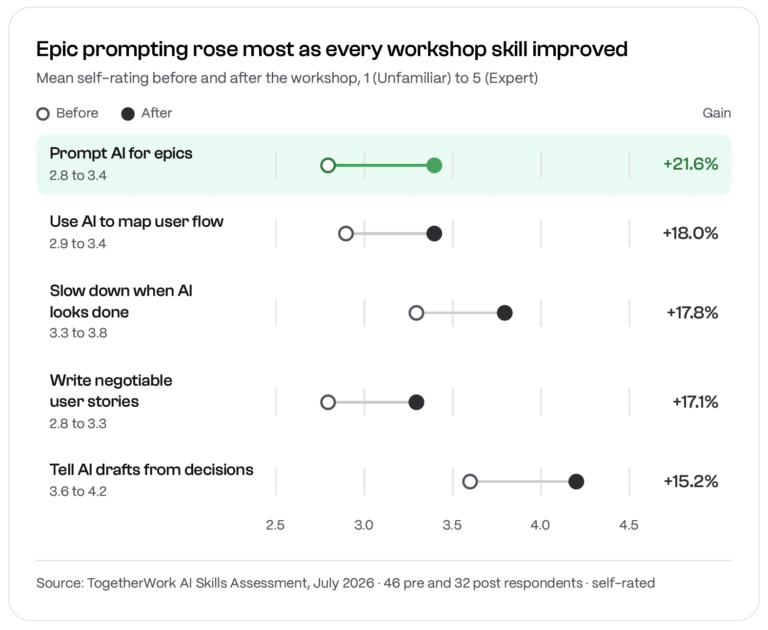
Productside surveyed Summit attendees before th workshop (46 responses) and again in July 2026 (32 responses). Average self-rated proficiency on the five workshop skills rose 18%, from 3.1 to 3.6 out of 5. General AI skills, which the workshop didn’t target, rose 7%, so the targeted skills improved at 2.5 times the rate.
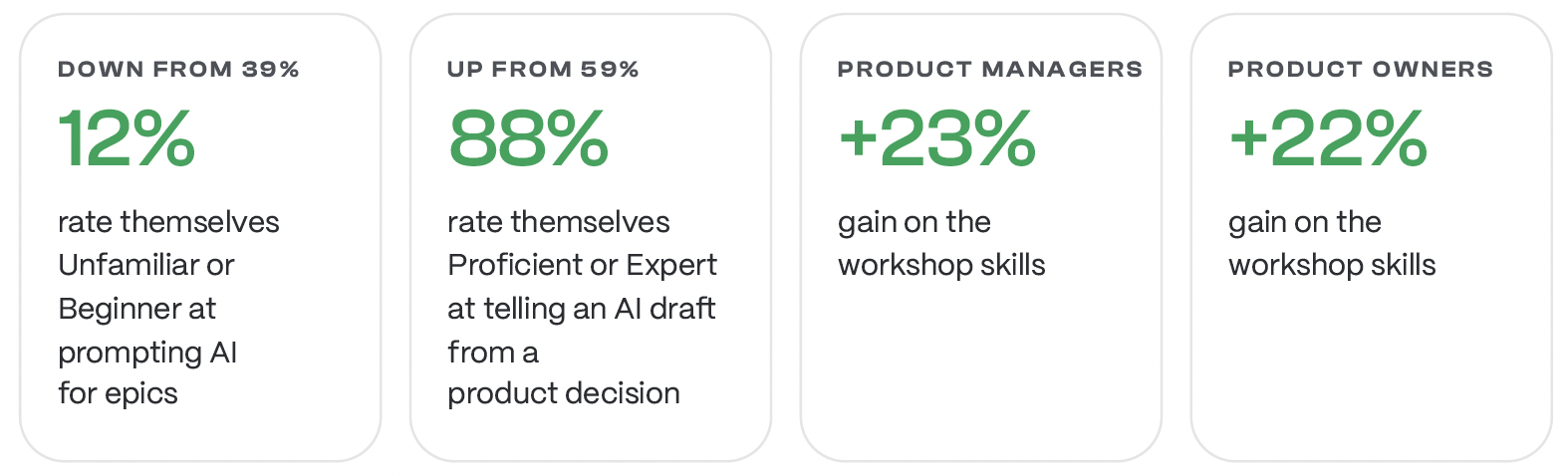
Epic prompting made the biggest jump. Before the workshop, 39% of respondents rated themselves Unfamiliar or Beginner at it; afterwards, only 12% did. The share rating themselves Proficient or Expert at telling an AI draft from a product decision climbed from 59% to 88%. Product managers and product owners, the roles the workshop focused on, gained most, at 23% and 22% on the workshop skills.
Better PRDs and epics in Jira
TogetherWork has no telemetry that flags work made with the PRD Writer, so Annie looks for it herself. Increasingly, she finds it.
"I was digging through Jira and I found an epic, and I thought this is really nice. And then I was like, oh, they used the skill to make this. It's really thorough. It has all the points hitting."
Annie Glass
Before the workshop, TogetherWork had no real culture of writing PRDs. Now they turn up across Jira, and the people using the skill say it gives them a stronger starting point.
"The PRD Writer gives us structure at the point where we need it most, turning an idea into a solid foundation that gets the work moving."
Alan A., Product Manager, Mission-Driven Vertical
A different conversation with engineering
The biggest shift came after the workshop, when PMs realized aligning up front didn’t have to be hard. A PRD on the table changes how a PM and a dev team spend their first conversation about a feature.
"If you put this document in front of somebody and you spend 20 minutes talking about it, that automatically changes the whole nature of your dynamic with your dev team."
Annie Glass
"Productside's training really helped my team increase the quality of our story writing, taught us the importance of a diverge-converge approach to collaborative AI use, and gave us a stronger shared framework for making product decisions as a team."
Wyatt B., Director of Product and Strategy, Recreation and Wellness Vertical
People, not just practices
One product manager had been underinvested in before the Summit, and things weren’t going well for him. By the end of the three days he was asking Annie when she could come help his team with agile practice. With a new manager’s backing, he has since built a feature with heavy use of AI and demoed it to half of TogetherWork’s executive team.
For Annie, stories like his are the real measure: “This was really the starting point for a lot of positive transformation across the business.”
Lessons Learned & Future Outlook
TogetherWork’s rollout offers a practical playbook for any product leader trying to raise the floor on AI.
1. Get everyone in the same room, working on real work
A shared day on live initiatives did what months of encouragement couldn’t. It gave every participant a first win and the same reference point for what good looks like.
"If you're having a hard time getting the baseline level of your org higher, I don't think there's anything better that you can do than to do a training like this, especially if you can get everyone in the same physical room and teach people something together that's catered to your specific needs."
Annie Glass
2. Teach the why alongside the tool
AI speeds up whatever habits a PM already has. Grounding the workshop in why requirements exist is what made the speed worth having.
"If you are a really good PM, it will multiply your really good PM work. If you are a mediocre PM, it will multiply your really mediocre PM work... It's the same problem as it's always been, just times 100."
Annie Glass
3. Pair a mandate with momentum
Making the PRD Writer a planning requirement set the floor. Onboarding and engineering leads asking for the PRD made it feel normal rather than imposed.
4. Plan for measurement before rollout
AI tools offer little usage data, and nothing marks an artifact as made with a skill. Annie’s advice in hindsight: solve traceability up front, even if that means hiding “a little purple monkey dinosaur” in the output to query against later.
5. Start ongoing support on day one
Weekly office hours became one of TogetherWork’s best levers for shaping practice. Annie’s one regret is not starting them right after the workshop.
What’s next
TogetherWork keeps building on the PRD Writer, starting with richer context: helping it read clickable prototypes and drawing on codebase context graphs to inform early architecture proposals. Its AI ambitions also reach beyond product. Brooke now leads AI governance for the whole company, and she runs it with the same playbook her product teams use, down to a prioritized backlog and a value calculator for every use case.
Your Power Users Already Get AI. Bring Everyone Else With Them.
Most product orgs have a few people doing impressive things with AI and a lot of people waiting to be shown where to start. Productside’s AI Product Management training gets your whole team using AI on real product work, grounded in the fundamentals that make the output worth shipping. We build each engagement around your tools and the decisions your teams make every week.
About Productside
For over 25 years, Productside has delivered expert-led product management certification programs, product management team training, product management framework tools, and resources that support your product management transformation.
We help product teams build real skills.
From hands-on workshops to templates, blogs, podcasts, case studies, and guides on product metrics, product roadmap development, and more, everything we create is built to move product work (and product careers) forward. Learn more at www.productside.com.