
If you’re a product manager wondering why your career isn’t moving as fast as you’d like, you’re not alone. It’s one of the questions I get asked most often, and it was the driving force behind a recent live Ask Me Anything session we ran at Productside. The answer isn’t what most people expect. How to advance your product management career isn’t primarily about shipping more features, managing more stakeholders, or getting better at writing requirements. It’s about closing the right skill gaps at the right time, and understanding what really separates a PM from a product leader.
Here’s what the data, and two decades of hiring and working alongside product managers, tells us.
The Skill Gaps Most PMs Don’t Know They Have
We surveyed over 5,700 product managers globally for Productside’s Product Management Skills Benchmark Report. The results were revealing. On average, PMs score highest in domain knowledge and customer understanding. Those are real strengths. But the areas where most PMs fall furthest below the benchmark are:
- Pricing: driving pricing decisions based on strategic opportunity and market context
- Competitive analysis: continuously tracking competitors and predicting their moves
- End-of-life planning: managing product retirement in a way that protects customer relationships and brand
Those happen to be the exact skills that separate a PM from a Director. They’re also the skills that are hardest to develop purely on the job, because most organizations don’t give PMs structured exposure to them.
The data also showed that product manager skills for promotion don’t develop evenly. Knowing where you are in that progression matters:
- Early career: Focus on writing requirements, understanding your team’s PM processes, developing business skills, and building effective marketing and launch skills.
- Mid-career: Shift attention to competitive analysis, pricing, and forecasting
- Aiming for Director or VP: Prioritize strategy, leadership, end-of-life planning, and PM process (where Directors outperform individual contributors by an average of 29%)
Knowing where you sit in that progression is the first step to figuring out how to advance your product management career with intention rather than just time.
Strategic Thinking Is the Job, Not a Bonus Skill
One of the most common questions we got in our recent AMA was some version of this: “How can I succeed as a PM in an organization that doesn’t really understand the PM role?”
My honest answer: it depends on whether leadership is open to change. I’ve been in organizations where the light bulbs went on when I reframed the PM role in terms of business outcomes. And I’ve been in organizations where, after a few months, I could tell they were never going to get it. I left. That’s a real option, and it’s worth knowing.
But here’s the deeper point. The reason organizations undervalue product managers is often because the PM hasn’t yet demonstrated the kind of strategic thinking that makes the role undeniable. This matters more than ever right now. Atlassian’s State of Product 2026 report found that nearly half of product teams don’t have enough time for strategic planning, and that only 12% of PMs find driving measurable business results rewarding (despite that being the top expectation organizations now have of the role). There’s a gap between what organizations want from PMs and what most PMs are spending their time on. Closing that gap is how you make yourself indispensable.
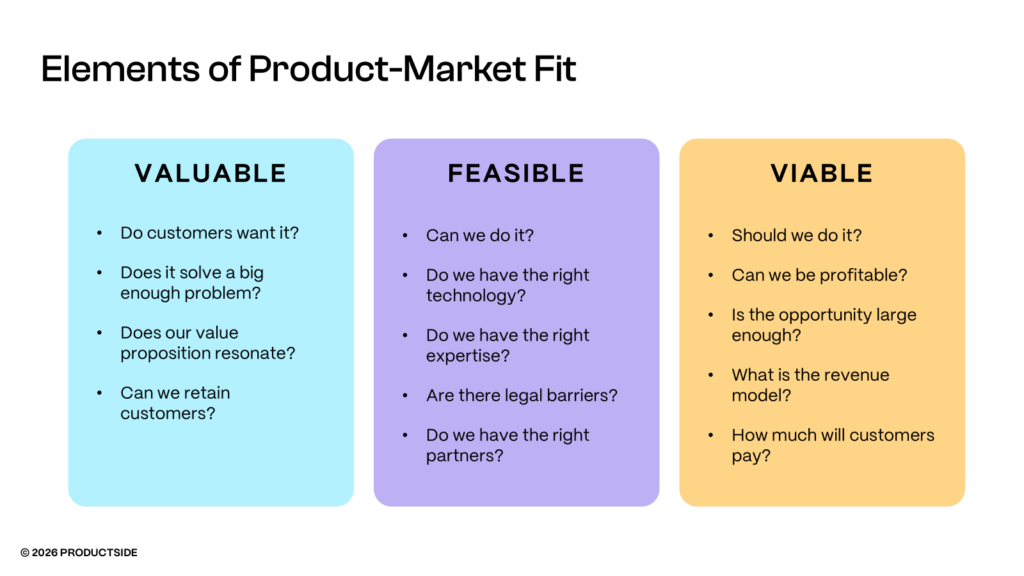
Product managers should operate as a mini-CEO of their product. Not in the sense of having authority over everyone (because you don’t), but in the sense of thinking about all three dimensions of product-market fit simultaneously:
- Valuable: Do customers actually want this? Does it solve a big enough problem that customers are willing to pay for it?
- Feasible: Can we build it? Do we have the right technology, expertise, and partners?
- Viable: Should we build it? Can we be profitable building this? Can we make this a long-term successful business?
When you start asking those questions out loud, in stakeholder conversations, in roadmap discussions, in discovery work, people notice. That’s what shifts perception. It’s also what makes leadership buy-in possible, and without leadership support, even the best PM will keep getting overruled in favor of short-term thinking.
The PMs who figure out how to advance their product management career fastest are the ones who stop waiting to be given strategic responsibility and start demonstrating strategic thinking in the work they’re already doing.
What Trained PMs Do Differently
Here’s a stat that should matter to anyone serious about product manager skills for promotion: trained PMs are, on average, 14% stronger across all 15 skill dimensions we track compared to untrained peers. That gap widens significantly in the areas that matter most for career progression:
- 20% stronger in end-of-life planning
- 17% stronger in overall PM processes
- 14% stronger in marketing and launch
- 12% stronger in strategy and competitive analysis
- 8% stronger in leadership
Instructor-led training graduates see 65% more career progression than those who study independently. And 31% of Productside-certified graduates received a promotion within a year of completing their certification.
Those numbers reflect something real about what structured learning does that on-the-job experience alone doesn’t: it gives you a framework for the decisions you’re already making and a shared language for the conversations that matter.
How to Advance Your Product Management Career in a Market That’s Changed
A question that came up repeatedly in our AMA was what it means to advance as a PM right now, in a market where AI is reshaping what organizations expect from the role.
Startups are increasingly hiring for what’s being called the “product engineer”: someone more technical, comfortable using AI coding agents, capable of shipping production code quickly. Research from 2026 shows that roles across product, design, and engineering are blurring faster than most organizations anticipated, with companies like LinkedIn replacing their Associate PM program entirely with a “Product Builder” program that trains generalists across all three disciplines. That’s worth paying attention to.
But here’s what I keep coming back to: the skill that sets a great PM apart isn’t the ability to ship code. It’s knowing whether you should ship it in the first place.
Strategic thinking. Business value. The real cost of feature bloat. The user experience tradeoffs that don’t show up in a ticket. Those aren’t soft skills. They’re the hardest skills to develop, and the ones most likely to determine whether your career stays flat or starts moving.
Today’s Product Manager must develop these skills while leveraging AI to be more efficient and effective. This came up strongly when we discussed re-entering the job market or transitioning into product management from another discipline. Here’s what I’d tell anyone in that position:
- Come AI-ready. Use AI tools in your research, discovery work, and interview preparation. There’s no excuse for showing up underprepared when 10 minutes with an AI can make you significantly more informed about the company you’re interviewing with.
- Demonstrate curiosity through how you use AI. Research the company, uncover uncomfortable questions, show that you’ve done your homework in ways that weren’t possible five years ago.
- Get hands-on. Vibe code, build an agent, pick a problem you want to solve and use AI to tackle it. Practical familiarity with these tools signals readiness in a way that talking about them doesn’t.
The fundamentals of great product management, like critical thinking, curiosity, product-market fit, business acumen… those don’t change. In fact, they are more important than ever. But the context you apply them in has shifted dramatically, and the PMs who advance fastest are the ones who embrace these critical skills and AI.
The One Trait That Predicts Career Growth
When I look back at the product managers I’ve hired, trained, and worked alongside over the past 20 years, one trait shows up consistently in the ones who move furthest: curiosity.
Not just curiosity about their product, but about the business, the market, the customer, and the broader forces shaping all three. The best PMs ask questions like:
- What business outcome is this feature actually meant to drive?
- What does it cost us to build this instead of something else?
- Is this market opportunity large enough to justify the investment?
- What does the customer actually need, versus what they said they want?
Those questions are the job. And the PMs who ask them consistently, document the answers, and use them to inform decisions are the ones who get promoted.
Knowing Your Next Step
How to advance your product management career isn’t a mystery. It comes down to three things:
- Know which skills to build next and be honest about the gaps between where you are and where you need to be
- Find structured ways to build them. On-the-job experience is valuable, but it has limits; training closes gaps that time alone won’t
- Demonstrate strategic thinking now, in every conversation, every decision, every question you ask
Product manager skills for promotion aren’t out of reach. But they don’t develop by accident either. The gap between where you are and where you want to be is real. It’s also closable, if you’re intentional about it.
- If you want to hear the full conversation on how to advance your product management career, including the live Q&A on AI, the engineering-to-PM transition, and what it takes to move into a leadership role, watch the complete AMA “How Do I Advance My Product Management Career?” Roger Snyder and Rina Alexin answer the questions product managers actually ask before committing to their next career move.
- If you want to go deeper, not just understanding where your skill gaps are, but building the strategic thinking, frameworks, and business acumen that get PMs promoted, join our Optimal Product Management course. It’s live online and instructor-led, with no more than 20 people per session, so you get real feedback on real work rather than another course you watch at 1.5x speed.
- What’s the biggest skill gap standing between you and your next step? Share your thoughts on LinkedIn and tag @Productside. We’d love to hear where you’re focused right now.